

What is Lexzur?
Lexzur is the agentic AI platform enterprise and government teams run their contracts, matters, legal requests and external counsel on, built on AI-native architecture on a proven system of record. Teams configure it around their own workflows and playbooks, starting with one department and expanding as their needs grow. Lexzur is trusted by leading enterprises and government entities.
At its core is LEXA AI, the intelligence built into every part of the platform. CONTRA by Lexzur provides AI Contract Lifecycle Management & Document Automation. PRACTICE by Lexzur provides AI Legal Practice Management. Both run on LEXA, bringing AI into the same environment where teams manage contracts and matters. LEXA is built in, not sold as a separate add-on.
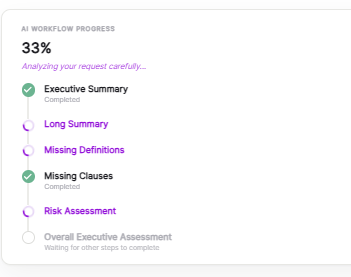
Teams configure AI Agents to draft, review, analyze and advance defined work, then connect them through reusable LEXA AI Workflows. People confirm every result.
But being able to use Lexzur and being a good fit for Lexzur are not the same thing.
The more useful question is whether the complexity, volume, and interconnected nature of your work justify a broader legal and contract management environment.
Where do CONTRA and PRACTICE fit across contract and matter work?
Lexzur addresses two major areas of legal work: contracts and matters. Understanding which area you are trying to improve is one of the easiest ways to determine which solution fits.
CONTRA: AI contract lifecycle management & document automation for every contract
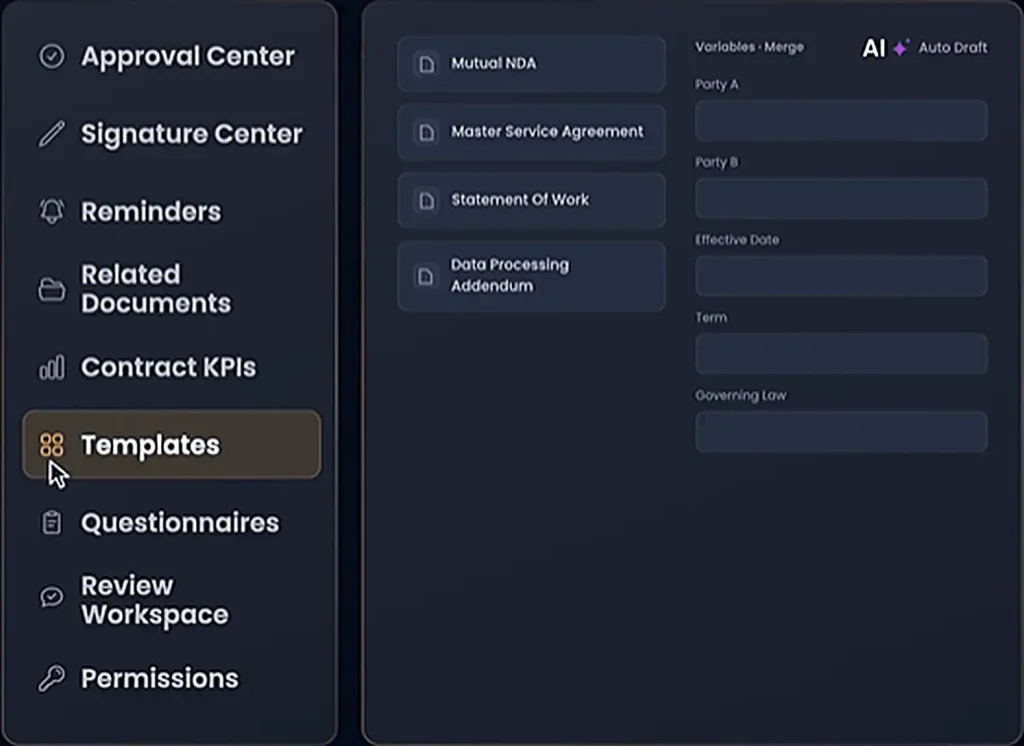
CONTRA is designed for teams that need to create, negotiate, approve, sign, track, and manage contracts through one lifecycle, from initial request through renewal. That includes every team involved in contract processes, from legal and procurement to HR, sales, finance and compliance. A supplier agreement, for example, may require input from procurement, legal, finance, and management before approval. After that come negotiation, signatures, obligations, key dates, and renewals.
As more people and stages become involved, teams need a reliable way to know where the agreement or deal stands, who needs to act, and what happens next. CONTRA helps teams manage that lifecycle, while LEXA AI Agents support drafting, review, negotiation, compliance and obligations within the process.
Key benefits of CONTRA
- Centralize the contract lifecycle in one environment
- Reduce reliance on email and manual follow-ups
- Standardize contract requests, reviews, and approvals
- Improve visibility into contract status and ownership
- Automate document creation and recurring processes
- Track obligations, renewals, and key dates
- Reuse configured LEXA AI Agents and Workflows for recurring contract work
Top CONTRA features
- Contract lifecycle management
- Document automation
- Contract templates
- Approval workflows
- Negotiation and review management
- E-signature integrations
- Obligation and renewal tracking
- Centralized contract repository and searchable contract database
- Reporting and dashboards
- Automation Hub
- LEXA AI Agents & Workflows
CONTRA may be a good fit if your main challenge is managing contracts from creation through post-signature activities.
PRACTICE: AI legal practice, matter, and case management software
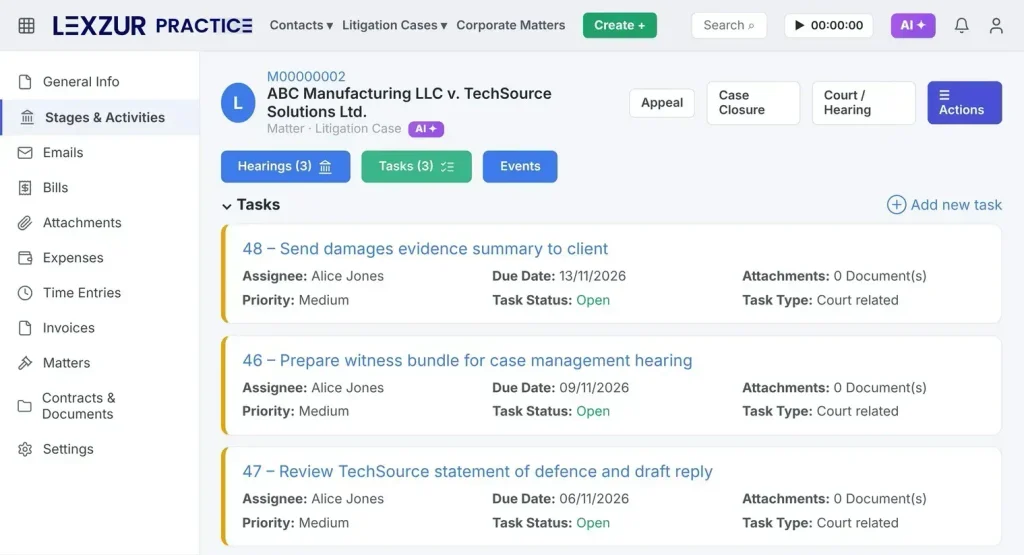
PRACTICE brings cases, clients, matters, tasks, documents, time, billing, workflows, and legal operations into one environment. For in-house teams, it supports internal legal requests, corporate matters, litigation, complaint handling, outside counsel, tasks, documents, deadlines, and reporting. For law firms, it supports the operational side of running legal work, from matter management and deadlines to time tracking and billing.
PRACTICE also supports Enterprise Legal Management (ELM) requirements, helping corporate legal departments organize matters, legal requests, outside counsel activities, and operational reporting within a structured environment. Because PRACTICE runs on LEXA, AI can also support activities taking place within matters and legal workflows.
Key benefits of PRACTICE
- Centralize matters, cases, tasks, and documents
- Improve visibility into the legal team’s workload
- Reduce reliance on spreadsheets and disconnected systems
- Strengthen deadline and responsibility tracking
- Improve time tracking and billing processes
- Standardize internal legal workflows
- Give leadership clearer operational reporting
- Apply configured LEXA AI Agents and Workflows within matter and document work
Top PRACTICE features
- Matter and case management
- Client management
- Task and deadline management
- Document management
- Time tracking
- Billing and financial management, including e-invoicing and multicurrency invoicing
- Legal request workflows
- Outside counsel management
- Dashboards and reporting
- Workflow automation
- Automation Hub
- LEXA AI Agents & Workflows
PRACTICE may be a good fit if your main challenge is managing cases, matters, legal requests, workload, billing, or broader legal operations.
Managing both contracts and matters? See how Lexzur connects CONTRA and PRACTICE →
What does “Agentic AI” mean in Lexzur, and how do teams build LEXA AI agents & workflows?
This is where Lexzur’s Agentic AI approach comes in.
Unlike standalone AI tools that require users to move between systems, LEXA brings Agentic AI into the same environment where contracts, matters, documents, and workflows are managed.
Teams can configure specialized LEXA AI Agents around defined tasks and instructions, then organize them into reusable LEXA AI Workflows. Each agent has a purpose, instructions, response behavior, available tools and reference data. Sequential workflows run steps in a defined order; Dependent workflows let later steps use earlier outputs; Router workflows select the appropriate agent or workflow path for the request.
One agent might review a document, another identify risk, another extract required information, and another perform legal or commercial analysis. Those agents can operate as part of a configured workflow, so teams do not need to start from a new prompt for similar work. Enabled workflows can run within LEXA in a module or through LEXA Chat. Automation Hub connects the wider workflow through triggers, conditions, and actions, including tasks, emails, document generation, and LEXA prompts.
The shift is from asking:
“Can AI answer this question?”
to:
“Can AI handle this defined part of our workflow according to the instructions and process we have set?”
People confirm every result. LEXA AI Agents support review and analysis within configured permissions, with audit records supporting oversight. Teams assess findings and supporting information before deciding what action to take. LEXA works inside contracts, matters, and workflows, while people retain legal judgment and approval authority.
Who is Lexzur for?
Lexzur leads with enterprise and government teams that need connected contract and matter workflows, with a separate PRACTICE track for law firms. Teams can start with CONTRA for Procurement, CONTRA for HR, or PRACTICE + CONTRA for in-house legal, then expand. Workflow complexity is a stronger indicator of fit than company size alone.
Lexzur is particularly relevant for:
- Enterprise and government legal teams seeking connected enterprise legal management
- Global and regulated organizations
- Procurement, HR, compliance, finance, sales, and other contract-heavy teams that need faster contract review
- Growing law firms
- The challenges each group faces are different, so the features and benefits that matter most to them are different as well.
In-house legal teams
In-house legal teams often manage work across contracts, matters, internal requests, disputes, outside counsel, documents, deadlines, compliance requirements, and reporting.
They may not need traditional law firm operations, but they still need visibility and control over an increasingly broad workload.
Many are also expected to handle that work without building a large legal operations function.
For corporate legal departments, these requirements are often part of Enterprise Legal Management (ELM), which focuses on organizing and controlling legal work, resources, processes, and reporting across the organization.
This is where having CONTRA and PRACTICE within the same Lexzur environment can matter. PRACTICE handles matter-driven legal work, while CONTRA manages the contract lifecycle.
Together, they support a more connected approach to Enterprise Legal Management, allowing legal teams to manage contracts and matters without treating them as entirely separate operations.
What matters most to in-house legal teams?
Key benefits
- One view across legal work: Bring contracts, matters, legal requests, tasks, and documents into a more connected environment.
- Better workload visibility: Understand what the team is handling, what is pending, and where attention is required.
- Structured legal intake: Give business teams a defined way to submit requests through the Client Portal.
- Improved business collaboration: Give procurement, HR, finance, sales, and other departments clearer processes for working with legal.
- Better outside counsel oversight: Keep external legal work connected to internal matters and reporting through the Advisor Portal.
- Clearer responsibilities and deadlines: Make it easier to see who owns each task and what comes next.
- More useful reporting: Give general counsel and legal leadership clearer visibility into legal activity.
- AI-assisted workflows: Apply LEXA AI Agents to recurring legal, contract, and document work.
Top features for in-house legal teams
- Internal legal request workflows
- Contract lifecycle management
- Outside counsel management
- Litigation and dispute tracking
- Dashboards and legal reporting
When would an in-house team choose Lexzur instead of another legal platform?
The useful question is not which product has the longest feature list.
Ask what you are trying to connect. If the department needs to manage both contract and matter work, standardize recurring processes, and gain a clearer picture of legal activity, a connected legal management environment becomes more relevant. For example, a commercial agreement may be managed through CONTRA while a related legal request, dispute, or corporate matter is handled through PRACTICE. That is a different requirement from needing only a contract repository or a single legal workflow.
Global and regulated organizations managing complexity across teams in a secure environment
For a multinational or regulated organization, legal technology decisions extend beyond day-to-day convenience.
Permissions, auditability, security, multiple offices, languages, regional requirements, integrations, and operational consistency all become part of the evaluation. Lexzur is designed to support organizations managing legal and contract work across teams and jurisdictions.
The platform supports multilingual operations, local currencies, regional formatting, and time zone alignment. It includes access controls and encryption. Lexzur is ISO certified, with GDPR compliance.
What matters most to global and regulated organizations?
Key benefits
- Operational consistency: Standardize legal and contract processes across offices, teams, and jurisdictions.
- Centralized visibility: Give leadership a clearer view of legal and contract activity across the organization.
- Controlled access: Manage permissions for sensitive matters, contracts, and documents.
- Greater auditability: Maintain clearer records of activity and workflow progression.
- Regional flexibility: Support multilingual and multijurisdictional operations.
- Deployment flexibility: Choose cloud, private SaaS or on-premises, depending on your security, data residency and regulatory requirements.
- Integration with existing systems: Keep specialized enterprise tools where they already work effectively.
- Structured AI adoption: Apply LEXA AI Agents within defined processes rather than as disconnected tools.
Top features for global and regulated organizations
- Role-based access controls, permissions, and user groups
- Audit and activity tracking
- Multilingual support, local currencies, regional formatting, and time zone support
- Cloud, private SaaS, and on-premises deployment
- API and enterprise integrations
Procurement, HR, compliance, finance, sales, and other contract-heavy teams
This is why Lexzur is not limited to lawyers. Legal, procurement, HR, sales, finance, compliance, and other teams can participate in contract and approval processes through the relevant CONTRA workflows and collaboration capabilities, without all becoming users of traditional legal practice management software.
A supplier agreement might begin with procurement, move to legal for review, require finance or management approval, go through negotiation and signature, and later require obligation or renewal tracking.
CONTRA can manage that lifecycle while keeping the relevant teams involved at the stages where their input is needed.
The value becomes clearer when several people, decisions, and stages need to work together.
What matters most to business and legal-adjacent teams?
Key benefits
- Faster contract processes: Reduce manual handoffs and unnecessary follow-ups.
- Clear contract status: Give stakeholders better visibility into where agreements stand.
- Structured approvals: Route contracts to the correct reviewers and decision-makers.
- Better collaboration with legal: Give business teams a defined way to involve legal when needed.
- More consistent document creation: Use templates and automation for repeatable agreements and standard contract content.
- Better post-signature control: Track obligations, renewals, and important dates.
- Reduced email dependency: Move contract activity into a structured lifecycle.
- AI-supported review and analysis: Apply LEXA AI Agents to repeatable contract work.
Top features for procurement, HR, compliance, finance, and sales
- Contract request workflows
- Document automation and contract templates
- Approval workflows
- E-signature integrations
- Obligation and renewal tracking
Not sure which Lexzur solution fits your team? Explore CONTRA, PRACTICE, and LEXA →
Growing law firms outgrowing email and spreadsheets
A growing law firm rarely decides overnight that it needs legal practice management software.
The pressure usually builds gradually. Cases are tracked in spreadsheets, deadlines live in individual calendars, documents sit across inboxes and shared drives, time is recorded somewhere else, and billing requires manual follow-up. Partners may also need reports that take too long to prepare. None of those methods necessarily fails on its own. The problem begins when running the firm requires too much manual effort just to keep everything aligned.
For firms reaching that point, PRACTICE can provide a more systematic way to manage legal work and the operations surrounding it.
What matters most to law firms?
Key benefits
- Better matter visibility: Give lawyers and partners a clearer view of active matters, responsibilities, documents, and deadlines.
- More reliable deadline management: Keep tasks, court dates, reminders, and responsibilities connected to the relevant matter.
- Improved billing accuracy: Connect time tracking and billing more closely to legal work.
- Centralized information: Keep client, matter, document, task, and financial information together in one database.
- Stronger reporting: Give partners and management clearer visibility into workload, productivity, billing, and operations.
- More consistent workflows: Standardize recurring processes rather than relying on individual working methods.
- AI-supported legal work: Use LEXA AI Agents for repeatable review, analysis, extraction, and document-related tasks.
Top features for law firms
- Matter and case management
- Task and deadline tracking
- Time tracking
- Billing and financial management, including e-invoicing and multicurrency invoicing
- Outlook and business-tool integrations
But is Lexzur overkill for a small law firm?
Not necessarily. Size is not the best way to judge fit. Complexity is. A five-person firm managing a high volume of matters, documents, deadlines, client communications, and billing may have a greater operational need than a larger boutique with simpler processes. Lexzur can also support flexible billing arrangements, including hourly and fixed-fee work. A small practice with straightforward requirements and a setup that already works well may not need to change anything.
Lexzur vs. point legal tools and enterprise legal management platforms: beyond a feature-by-feature comparison
Legal technology buyers often face a choice between specialized tools and broader enterprise legal management environments.
A point solution can work well when the requirement is specific, such as e-signature, document storage, time tracking, or another isolated capability. At the other end, large organizations may operate multiple specialized applications connected through integrations and customized processes. Lexzur takes a connected approach by bringing contract lifecycle management, legal operations software, workflows, documents, reporting, integrations, and Agentic AI into the same ecosystem.
Its differentiation is not simply offering several legal technology capabilities together. It is bringing LEXA’s Agentic AI capabilities into the contract and matter workflows managed through CONTRA and PRACTICE.
That does not automatically make a connected platform preferable.
Specialized applications can be the right choice when an organization has specific requirements and the resources to maintain them.
Lexzur becomes more relevant when several areas of contract and legal work need to operate together.
The decision is therefore less about which platform has more features and more about what your organization needs to connect.
Does Lexzur reduce administrative work or just add another system to update?
That depends on how it is implemented.
A legal management platform only reduces administration when repetitive work actually moves into it rather than continuing through parallel spreadsheets, inboxes, trackers, and manual processes. That can mean reducing duplicate data entry, replacing manual trackers, automating defined steps, and using LEXA AI Agents or workflows for recurring work. The goal should be consolidation, not duplication. Before implementation, determine which processes Lexzur will manage, which systems should remain connected, and which manual steps should disappear.
What does switching to Lexzur actually look like?
There is a learning curve. Implementation may involve importing information, organizing matters and contracts, setting permissions, configuring workflows, connecting systems and training teams. Admins can configure standard fields, approvals, templates, reports and automations without code. Lexzur assesses integration work and development beyond standard configuration separately. Start with one meaningful workflow, then expand.
For an in-house legal department, that might be legal requests or contract review. For procurement, it might be supplier approvals. For a law firm, it might be matter management. Get that process working first, then expand. The same applies to AI. Teams do not need to automate everything on day one. Start with repeatable work where the expected process is already clear, then introduce more advanced LEXA AI Agents and workflows as users become comfortable. The goal is adoption, not maximum configuration from day one.
What should buyers know about Lexzur pricing and ROI?
Lexzur offers different plans across CONTRA and PRACTICE, with varying capabilities for automation, integrations, storage, permissions, and enterprise configuration.
Confirm pricing, required capabilities, integrations, extensions, deployment and services through a tailored proposal. LEXA is built into the platform rather than sold as a separate add-on. Assess value against the cost of delays, missed renewals and repetitive administrative work.
A useful ROI assessment should consider:
- How many separate tools or manual trackers could be consolidated?
- How much repetitive administrative work could be reduced?
- Could contract, matter, billing, or approval workflows become more efficient?
- Could better visibility and reporting reduce time spent chasing information?
Customer results provide examples, though they should not be treated as guaranteed outcomes.
Aida Holding, for example, reported 60% faster contract processing after moving its contract work onto Lexzur.
These results illustrate how centralizing legal work can improve operational efficiency, although actual outcomes depend on each organization’s workflows, implementation, and adoption.
The greater the fragmentation in your current processes, the more opportunity there may be to generate value through consolidation and automation.
How does Lexzur integrate with the rest of your technology stack?
Adopting Lexzur does not necessarily mean replacing the systems your organization already uses.
A document management platform may already handle documents effectively, while an e-signature service may already handle signing well. Those systems can remain in place. Lexzur completes the organization’s technology stack through native integrations with tools such as Microsoft Outlook, Google Workspace, Microsoft Teams, DocuSign, Adobe Acrobat Sign and cloud document platforms, plus REST APIs and webhooks. In total, you can connect Lexzur to 9,000+ apps (26 native integrations + thousands more via Zapier).
This allows specialized applications to remain in place while broader legal and contract processes are managed through Lexzur. For example, Outlook Connect can link emails and attachments directly to matters, tasks, and other records in Lexzur.
The implementation question therefore does not always have to be:
“What do we need to replace?”
It can instead be:
“Which systems should remain, and how should they connect to the legal and contract workflows Lexzur will manage?”
If your current enterprise legal stack already meets your requirements, integrations work well, and users are satisfied, migration may provide little additional value. Newer technology alone is not a reason to migrate. Integration availability can vary by product, plan, deployment, and add-ons, so organizations should confirm specific requirements during evaluation.
How does Lexzur approach security, data protection, and trust?
For legal teams, trust starts with knowing that sensitive data stays secure.
Lexzur is ISO certified, with GDPR compliance.
Lexzur documents the following controls:
- TLS/SSL encryption for data in transit
- AES-256 full-disk encryption for server drives holding customer data
- Access permissions and user groups
- Session monitoring and login auditing
- Tenant isolation
- Periodic independent security testing
Lexzur never uses your data to train AI models. Organizations can choose cloud, private SaaS or on-premises deployment, depending on security, infrastructure, data residency, and regulatory requirements.
Security evaluation should therefore consider certifications as well as the deployment model, access controls, data requirements, integrations, and internal security policies relevant to your organization.
What can teams expect during adoption, and what support is available?
A platform covering matters, contracts, workflows, billing, integrations, reporting, and AI naturally requires more onboarding than a single-purpose tool.
Lexzur provides a Documentation Center, technical guides, knowledge resources, training, and multilingual support through its support channels and Customer Portal. Additional Solution Expert services can support configuration, migration, integration, administration, and optimization. Lexzur Academy provides product training and certification for every team using Lexzur. Adoption can begin with one team and expand as teams become comfortable.
A useful principle is:
Start with one process people genuinely need, make it work well, and then expand.
Still not sure? Take this quick Lexzur fit check
Lexzur may be worth evaluating if several of these apply:
- Important matters, contracts, deadlines, or approvals still rely heavily on spreadsheets, inboxes, or shared drives.
- People regularly copy the same information between systems.
- You manage both contracts and matters but have limited visibility across them.
- Multiple teams participate in the same contract or approval processes.
- It is difficult to see the status of work without asking people for updates.
- Repetitive legal or contract tasks follow processes that could be standardized or automated.
- You want AI to operate within contracts, matters, and workflows rather than as a separate tool.
If most of these do not apply and your current processes are simple and working well, a narrower solution may be enough. The right legal technology is the one that matches the work you actually need to manage.
Which part of Lexzur should you explore next?
If your priority is contract lifecycle management and document automation, explore CONTRA. If your priority is matters, cases, clients, time, billing and legal operations, explore PRACTICE. If you want to understand how built-in Agentic AI supports both, explore LEXA AI Agents & Workflows.
Ready to make legal work easier to manage?
Lexzur is most relevant when contracts, matters, approvals, documents, and legal workflows become difficult to coordinate across separate tools and processes.
For in-house teams, it can mean connecting contracts, matters, legal requests, outside counsel, and reporting.
For global and regulated organizations, it can mean standardizing legal operations while maintaining the permissions, security, deployment flexibility, and integrations the organization requires.
For business teams such as procurement, HR, finance, compliance, and sales, it can mean creating clearer and more controlled contract workflows.
For law firms, that can mean bringing matters, deadlines, billing, and documents into a more structured environment.
Across these teams, LEXA brings Agentic AI directly into the contracts, matters, and workflows they manage, helping turn repeatable legal tasks into structured, AI-supported processes.
If your current setup is simple and already works well, a specialized solution may be enough.
The better question is:
Has managing the work become harder than doing the work?
If it has, a smarter, more connected approach may be worth exploring.
See how CONTRA, PRACTICE, and LEXA can fit the way your team works. Book a demo.
Frequently asked questions about Lexzur
Yes. In-house legal teams can use Lexzur across matters, contracts, internal requests, approvals, outside counsel, documents, and reporting, particularly when those activities require greater coordination and visibility.
Not necessarily. Lexzur can connect with existing systems, allowing organizations to keep specialized tools where they already work well while using Lexzur to manage broader legal and contract processes.
CONTRA manages the contract lifecycle and automates document creation.
PRACTICE manages matters, cases, clients, time, billing, and legal operations.
LEXA is the AI layer built into the Lexzur Platform, providing Agentic AI capabilities across both.
Agentic AI in Lexzur means configuring LEXA AI Agents for defined tasks and connecting them through reusable LEXA AI Workflows. Sequential, Dependent, and Router modes organize how those agents work together. Teams can reuse configured workflows for document review, risk identification, information extraction and legal or commercial analysis. People confirm every result before action is taken.
Yes, depending on the complexity of the firm’s work. A smaller firm managing a high volume of matters, documents, deadlines, billing, and client activity may benefit from PRACTICE. If its requirements are straightforward and its current processes already work well, a lighter solution may be enough.

Leave a comment