


AI for Legal: How Law and AI Are Redefining Modern Legal Practice
Summary:
Legal teams face increasing workloads, stricter regulations, and growing expectations — without the option to expand headcount. This article studies how AI for legal and AI in legal practice are transforming legal operations, why general tools like ChatGPT are not enough for professional use, and how LEXA by Lexzur, an AI legal platform, allows legal teams to reduce risk, improve work, and operate more strategically.
The New Reality for Legal Teams
Legal teams today are being asked to do more, faster, and with less risk — without increasing headcount.
Across law firms and in-house legal departments, workloads are increasing while regulatory pressure increases, budgets squeezed, and clients expect faster turnaround with greater certainty. Traditional legal workflows rely on manual review, disconnected systems, and slow processes — were not built to ahndle pressure .
This reality is turning AI for legal from an emerging trend into an operational necessity.
Rather than replacing lawyers, artificial intelligence is reshaping how legal work gets done. By accelerating analysis, automating repetitive tasks, and surfacing risk earlier, law and AI together allow legal teams to meet growing demands while maintaining accuracy, compliance, and professional judgment.
This change is driven by AI legal assistants such as LEXA by Lexzur, which build AI directly into daily legal work moving beyond experimentation toward reliable for large legal teams.
1. What Is AI for Legal?
AI for law means employing AI technologies that were created specifically for doing legal work. Using advanced language models, machine learning, and natural language processing (NLP), these systems can read and understand legal documents.
Modern legal AI software can do things that older legal software couldn’t.
- Learn about legal phrases that are hard to understand.
- Analyze a huge number of contracts and other papers
- Find out what risks and responsibilities you have and what changes you need to make.
- Organize and summarize legal information
- Help people make judgments faster by giving them more information.
AI’s job in the legal industry isn’t to automate things just for the sake of automating them. Its job is to make things better so that lawyers may focus on strategy, judgment, and critical legal work.

2. What is the relationship between law and AI?
The greatest legal groups know that AI and the law do different things that work well together.
AI is great at:
- Quickly processing a lot of information
- Keeping documents consistent
- Finding patterns and strange things
Lawyers are really good at:
- Using legal judgment and the situation
- Taking care of moral and legal duties
- Giving clients advice and making plans
AI can help with ordinary tasks, but lawyers are still fully liable for the results, read more about The AI Lawyer’s Assistant: How AI is Streamlining Legal Workflows
3. Main Uses of AI in the Legal Field
AI is already improving a number of legal processes, such as:
- Reviewing and analyzing documents
- Managing the life cycle of a contract
- Researching and summarizing legal issues
- Monitoring compliance and risk
- Litigation and case preparation
These examples highlight how AI can make legal work more efficient and consistent without lowering professional standards. Read the 5 Ways Enterprises Can Improve Contract Negotiation with AI
4. The Rise of ChatGPT and Generative AI for Legal
Now that generative AI is getting more popular, people are more interested in legal AI technology. A lot of lawyers are using ChatGPT for legal work, like
- Writing the earliest drafts of papers
- Summarizing long texts
- Developing legal arguments
If you use these tools the right way, you can get more done. But their limits become evident when they are used for professional, high-risk legal work. learn more about ChatGPT for Lawyers: Everything Lawyers Need to Know About Chat GPT
5. The Limits of Generic Legal AI Tools
Generic AI tools like ChatGPT are not designed for legal operations.
Key limitations include:
- Not being able to work with legal workflows
- No built-in compliance or risk management
- Limited context across contracts, cases, and duties
As the amount, difficulty, and risk of legal labor grows, these limits become increasingly obvious.
These limitations explain why legal teams are moving from experimentation toward integrated, AI-powered legal platforms. and AI contract reviews
6. From Experimentation to AI Legal Platforms
Rather than relying on standalone tools, modern legal teams are embedding AI directly into legal systems.
AI legal platforms:
- Understand legal documents and legal context
- Operate within secure, governed environments
- Support legal judgment instead of replacing it
This shift reflects the evolution of AI for legal practice — from ad-hoc experimentation to operational infrastructure.
7. LEXA by Lexzur: AI for Legal in Action
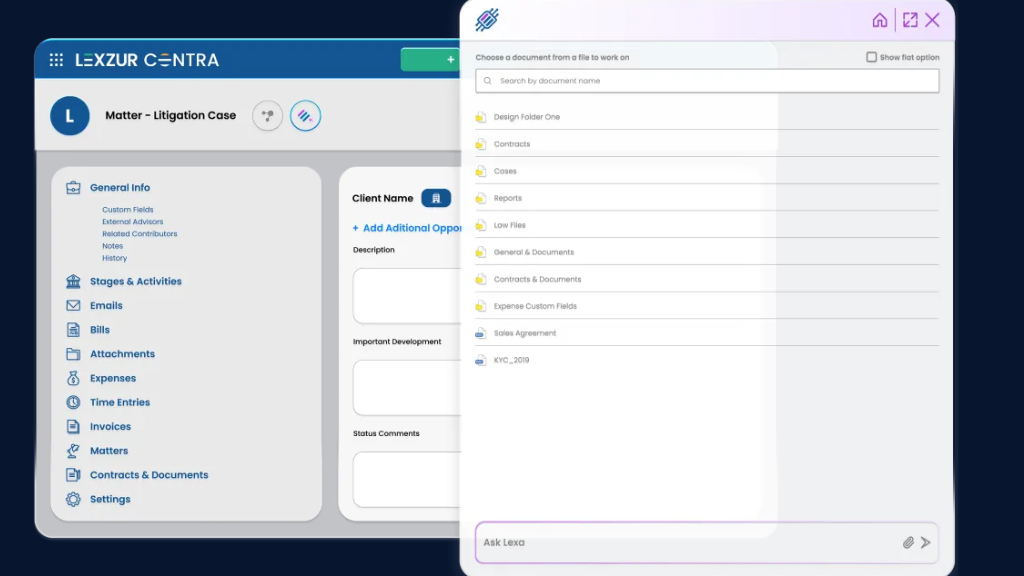
LEXA is the AI assistant built into the Lexzur legal platform, designed specifically for legal professionals.
Unlike generic tools, Lexa operates within structured legal workflows and understands contracts, clauses, cases, and compliance requirements. It represents how legal AI software delivers real, practical value when built for legal work from the ground up.
Lexa’s Most Important Features
- Analysis of smart contracts and clauses
- Risk assessment and compliance
- Summarizing legal documents
- Analysis of cases and extraction of insights
- Legal translation in more than one language
Mini Case Scenario: Checking a Contract’s Due Diligence
During a due diligence review involving 500+ commercial contracts, a legal team may need to identify non-standard termination clauses, hidden auto-renewals, or unfavorable liability language.
LEXA finds unusual clauses, points out differences from permitted wording, and shows where risks are highest. All of this work would normally take days or weeks to do by hand.
Lawyers still make all the decisions, but AI speeds up the review process and lowers the chance of missing something.
8. Mini Case Scenario: Litigation and Case Preparation
Lexa can find crucial facts, timings, and arguments among hundreds of pages of letters, briefs, and exhibits in a lawsuit.
Lawyers don’t have to make timelines by hand anymore. Instead, students obtain a methodical review that shows them facts that are in dispute and common legal issues. Instead than sifting through files, this enables them get right to work on strategy, planning movements, and offering clients guidance.
This is how AI and the law work together to get tasks done and help teams think about how to do things better.
9. What are the benefits of AI for legal teams?
Businesses that use AI-powered legal systems see:
- More productive
- Faster turnaround times
- Reduced operational costs
- More precise and reliable
- More information about legal and regulatory risks
AI lets lawyers stop doing work that is reactive and start doing work that is proactive and strategic.
10. Using Legal AI Responsibly
Adopting AI must be done in a responsible way.
Best practices include:
- Keeping an eye on people
- Using secure, purpose-built platforms
- Keeping client data safe
- Following ethical and legal rules
Lexzur and other platforms are designed to help organizations use AI in an ethical way.
11. The Future of Law and AI
The law will function together in the future.
AI will become a common legal tool, like digital research or document management. Lawyers will still be in charge of making decisions, following the law, and speaking out for their clients.
The next wave of legal greatness will come from legal teams that use AI in a responsible way.
What sets Lexzur’s LEXA apart from other lawful ChatGPT tools?
LEXA is part of a legal operations platform and is designed only for legal work, like checking contracts to make sure they respect the law and looking at cases.
Legal teams can no longer rely on manual processes or solutions that don’t work together to meet their goals.
If you want to:
- Lower the chance of getting into legal trouble
- Speed up reviews of contracts and cases
- Run your business more strategically without hiring more people.
👉 Find out how LEXA by Lexzur’s AI legal procedures, which are designed for real legal work, help legal teams take less risks, speed up reviews, and operate more strategically.
In the future, Lawyers will plan, lead, and keep law and AI safe. Now is the time to take command. if you are a lawyer read AI for lawyers & The Top 10 Questions Lawyers Ask About AI: Answered
Frequently Asked Questions (FAQ)
AI for legal is a type of artificial intelligence that helps with legal work. It matters because legal teams have more work to do, more rules to follow, and less money to spend.
AI handles high-volume, repetitive tasks, while lawyers apply judgment, strategy, and accountability.
Generic tools can help you write and summarize, but legal AI platforms that are created for a specific purpose are better because they are more dependable, safe, and easy to use in your work.



Leave a comment