











The Silent Bottleneck Slowing Enterprise Growth
A vendor is approved. The business is ready to move.
But the contract sits in someone’s inbox, waiting for internal approvals.
For many enterprise procurement teams, this is not an exception. It’s part of the process.
According to McKinsey & Company, employees spend nearly 20% of their workweek searching for information or tracking down colleagues to move work forward.
In procurement, that inefficiency shows up most clearly during vendor approvals. Progress depends on multiple stakeholders, disconnected systems, and constant follow-ups.
Across the region, teams are under pressure to move faster while navigating layered approvals and growing compliance demands.
Vendor approvals don’t slow down because of complexity; they slow down because no one owns the process end-to-end.
Why Vendor Approvals Still Get Delayed in Enterprise Environments
Fragmented Workflows Across Departments
Approvals don’t stall because teams lack expertise. They stall because teams aren’t connected.
Procurement, legal, and finance often operate in parallel, each using their own tools and processes. Emails move back and forth. Spreadsheets are updated manually. Visibility disappears quickly.
The outcome is predictable:
- Ownership becomes unclear
- Follow-ups increase
- Delays become normalized
Manual Contract Review Cycles
Many organizations still rely on inbox-driven contract reviews.
Legal teams review documents independently. Procurement teams wait for feedback without clear timelines. The same clauses are reviewed again and again.
At scale, this creates friction that builds over time rather than resolving itself.
Increasing Compliance Complexity
Compliance requirements are expanding. Documentation expectations are higher. Audit trails are no longer optional.
But structure hasn’t always kept up.
When compliance workflows are inconsistent, teams spend more time checking than progressing. Reviews become repetitive. Approvals slow down—not because compliance is unnecessary, but because it isn’t embedded into the process.
Lack of Standardization
Every variation in process introduces delay.
Different contract formats. Different approval paths. Different expectations across departments.
Without standardization, even routine vendor onboarding becomes unpredictable. Teams spend time aligning instead of executing.

The Business Impact: Why Delays Matter
Vendor approval delays rarely stay contained within procurement.
They affect how quickly projects start, how efficiently teams operate, and how confidently the business can move forward.
Operational Impact
- Project timelines stretch
- Dependencies pile up
- Execution slows
Financial Impact
- Opportunities are delayed
- Costs increase
- Resources sit idle
Compliance Risk
- Gaps in documentation
- Missed requirements
- Greater exposure to disputes
Most organizations don’t have an approval problem.
They have a coordination problem disguised as process.
What Barriers Prevent Procurement Teams from Delivering Innovation?
Innovation doesn’t usually fail because of lack of ideas. It slows down because execution can’t keep up.
For procurement teams, vendor approvals are often the hidden constraint.
New technologies, strategic partnerships, and external capabilities all depend on how quickly vendors can be onboarded. When approvals are delayed, innovation doesn’t stop—it gets postponed or quietly deprioritized.
Several barriers stand out:
1. Process Ownership Gaps
Approval processes often move across teams without clear accountability.
Procurement initiates. Legal reviews. Compliance checks. But no one owns the full journey.
Progress slows at every handoff.
2. Rigid, One-Size-Fits-All Workflows
Not every vendor carries the same level of risk. Yet many organizations apply identical processes to all cases.
Low-risk vendors get stuck in complex workflows. Strategic initiatives wait behind routine approvals.
Innovation competes with process instead of being supported by it.
3. Limited Visibility Across Stakeholders
Teams often lack visibility into where approvals stand.
They don’t know:
- What stage a request is in
- Who needs to act next
- Why delays are happening
Without visibility, delays become invisible until they become critical.
4. Compliance Without Integration
Compliance is essential. But when it operates outside structured workflows, it becomes a bottleneck.
Reviews are repeated. Requirements are reinterpreted. Processes slow down.
5. Over-Reliance on Manual Coordination
Innovation depends on speed. Manual processes depend on follow-ups.
Emails, reminders, and status checks create a system where progress relies on individuals rather than process design.
That model doesn’t scale.
Procurement doesn’t block innovation intentionally.
But when approval workflows aren’t designed for speed, they become the constraint that holds innovation back.
How Leading Organizations Are Keeping Approvals Moving
Forward-thinking enterprises are rethinking how work flows between procurement and legal.
Instead of managing approvals across disconnected tools, they are building structured, shared workflows.
In the LegalTech Middle East landscape, platforms like Lexzur are helping organizations bring procurement, legal, and compliance into one system, so approvals move with clarity, not friction.
1. Centralizing Vendor Approval Workflows
When information is scattered, decisions slow down.
Centralized workflows create a single environment where all stakeholders can:
- Track approval status
- Understand ownership
- Act without delay
The shift is simple but powerful. Instead of chasing approvals, teams manage them in real time.
2. Accelerating Contracts with CLM
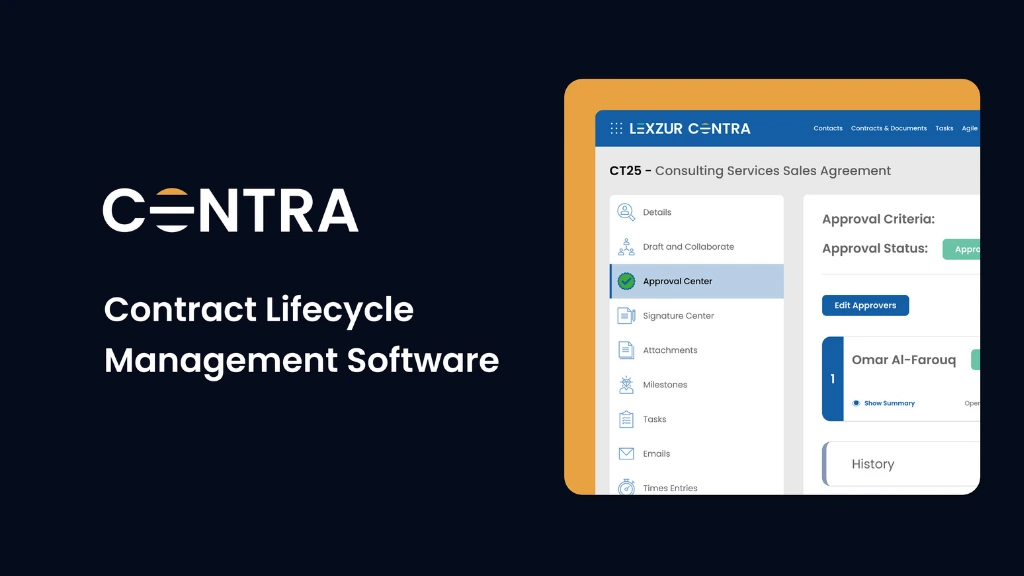
Contract Lifecycle Management (CLM) is often treated as a legal function. In practice, it directly impacts how fast procurement can operate.
CLM doesn’t just manage contracts,it removes the friction that slows the business down.
With structured templates, pre-approved clauses, and built-in workflows, contracts move faster from draft to approval.
3. Embedding Legal Earlier in the Process
Timing matters.
When legal is involved late, revisions increase and timelines extend. When legal is part of the process earlier, issues are addressed upfront and approvals move more smoothly.
This shift changes the role of legal. It becomes part of the workflow, not a checkpoint at the end.
4. Automating Approval Workflows
Workflows often rely on people to move them forward. That dependency creates delays.
Automation changes that dynamic.
Approvals are routed automatically. Escalations happen when needed. Progress continues without constant follow-up.
If approvals depend on inboxes, delays are inevitable.
5. Moving from Digitization to Workflow Intelligence
Digitizing documents is not transformation—it’s just storage.
Real transformation happens when workflows are connected end-to-end.
This is where modern enterprise legal software is redefining how approvals move. Instead of managing contracts and approvals in isolation, organizations are building structured, connected workflows that align procurement, legal, and compliance.
Lexzur enables this shift by bringing contract lifecycle management, approval workflows, and legal operations into a unified environment allowing approvals to move with clarity, consistency, and control.
In high-performing organizations, approvals don’t wait for people. Processes move on their own.
Bridging Procurement and Legal: A Strategic Shift
The difference between slow and fast organizations is rarely effort. It’s how work is structured.
Procurement and legal teams that operate separately create friction. Teams that operate within shared workflows move faster and with more control.
The goal is not just better tools. It’s better alignment.
Actionable Takeaways for Procurement Leaders
To reduce delays and improve efficiency:
1. Map Your Current Process
Identify where approvals slow down and why.
2. Standardize Where Possible
Reduce variation with templates and defined workflows.
3. Adopt CLM
Use Contract Lifecycle Management (CLM) to streamline contract handling.
4. Improve Collaboration
Enable shared visibility between procurement and legal teams.
5. Automate Workflow Movement
Remove reliance on manual follow-ups.
6. Track Performance
Monitor approval timelines and identify bottlenecks early.
The Future of Vendor Approvals in the Region
As regulatory expectations increase across GCC countries, organizations are accelerating investments in enterprise legal software and workflow automation.
The organizations moving ahead are not necessarily using more tools. They are connecting the ones they have and redesigning how work flows.
That shift will define how quickly businesses can operate in the years ahead.
Conclusion: Speed Is a Process Decision
Speed and compliance were once seen as competing priorities. Today, they reflect how well processes are designed.
The fastest organizations are not cutting corners. They have removed the friction others still accept.
More enterprises are turning to platforms like Lexzur to build connected workflows that keep approvals moving without compromising control.
Frequently Asked Questions (FAQs)
1. Why do vendor approvals take so long in large organizations?
Delays are usually caused by disconnected workflows, unclear ownership, and reliance on manual processes.
2. How can procurement teams speed up approvals without increasing risk?
By standardizing workflows, automating approvals, and using Contract Lifecycle Management (CLM) to maintain compliance while improving speed.
3. What role does CLM play in vendor approvals?
CLM helps manage contracts from creation to approval within a structured system, reducing delays and improving consistency.
4. How can legal and procurement teams collaborate more effectively?
By working within shared workflows. Platforms like Lexzur help align both functions and reduce coordination gaps.
Vendor approval delays aren’t inevitable. They reflect how your processes are designed.
How does your current approval workflow compare?
See how organizations are improving speed and control with connected legal and procurement workflows powered by Lexzur.
👉 Evaluate your process and identify where approvals are slowing down.

Leave a comment